

You've made the decision. You know which branch you want, you know why you want it, and you deserve the move. But you're staring at a blank document and every branch transfer request letter format you find online reads like it was written by a bored HR robot in 1997.
Here's the real problem: a vague, personal-sounding letter gets filed in the "we'll think about it" drawer and stays there. Managers who approve transfers are not doing you a favour. They're making a business decision. Write a letter that speaks to that decision, and you skip the endless waiting game entirely.
This guide gives you the exact format, two ready-to-use templates, and a follow-up plan. Think of it as the cheat code for the transfer boss fight.
Why Most Branch Transfer Request Letters Fail Before the Second Paragraph
Most employees write their transfer letter the wrong way. They lead with their own situation, their commute, their family, their stress and forget that the person reading it is thinking about one thing: what does this cost me, and what do I get?
The "please help me" trap and why it tanks approval rates
A letter that opens with personal hardship puts the manager in an uncomfortable position. They are not your therapist. When the first paragraph is all about your needs, the reader's instinct is to sympathise but delay.
The fix is simple. Frame every personal reason as a business benefit. You are not moving because your commute is brutal. You are moving so you can be closer to a key client region and deliver better results.
Here is what that contrast looks like in practice:
- "I am struggling with the long commute and it's affecting my performance." · What the manager reads: "This person wants me to solve their personal problem."
- "I feel I would thrive in a different environment." · What the manager reads: "No evidence. Vague. Easy to ignore."
- "Relocating would let me support the Mumbai branch's expansion with my existing client relationships." · What the manager reads: "There's a business case here. Let's talk."
What hiring managers and branch heads actually scan for first
Decision-makers scan for three things: your current role, your requested destination, and your reason. If those three items are not clear in the first paragraph, the letter fails before the second sentence lands.
Keep the opening clean and direct. State the transfer request in one sentence. Everything else is supporting evidence for a decision they have already started forming.
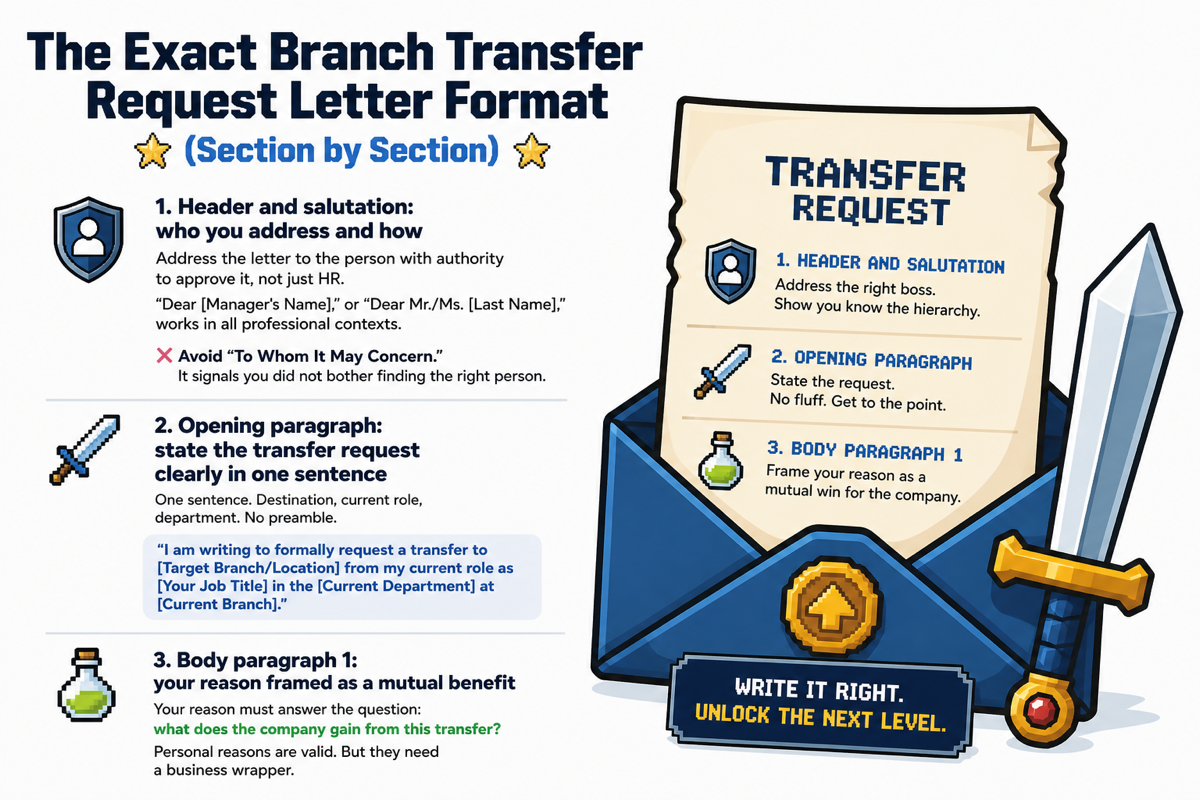
The Exact Branch Transfer Request Letter Format (Section by Section)
A well-structured branch transfer request letter follows a clear sequence. Each paragraph does a specific job. Nail the sequence and the letter writes itself.
Header and salutation: who you address and how
Address the letter to the person with authority to approve it, not just HR.
In most organisations, this is your direct manager or the branch head. CC the HR department if company policy requires it, but the primary recipient should be the decision-maker. Getting this wrong signals you do not understand the internal structure.
"Dear [Manager's Name]," or "Dear Mr./Ms. [Last Name]," works in all professional contexts. Avoid "To Whom It May Concern" — it signals you did not bother finding the right person.
Opening paragraph: state the transfer request clearly in one sentence
One sentence. Destination, current role, department. No preamble.
Do not warm up. Do not say "I hope this letter finds you well" and spend two sentences building to the point. State the request immediately so the reader knows exactly what they are evaluating.
"I am writing to formally request a transfer to [Target Branch/Location] from my current role as [Your Job Title] in the [Current Department] at [Current Branch]."
Body paragraph 1: your reason framed as a mutual benefit
Your reason must answer the question: what does the company gain from this transfer?
Personal reasons are valid. But they need a business wrapper. A family relocation is also an opportunity to strengthen the company's presence in that region. A health reason can be framed around maintaining your productivity and availability without interruption.
"Relocating to the [Target Branch] will allow me to [specific business benefit, e.g., support the regional team during peak season / reduce client response time in the northern territory], while also addressing a personal circumstance that affects my long-term stability with the company."
Body paragraph 2: your qualifications and continuity plan
Show that approving this transfer costs the current branch nothing they cannot recover.
This paragraph removes the manager's biggest objection: "But then who covers your work?" Mention your willingness to train a replacement, complete ongoing projects before the move, or overlap during a transition period. Then briefly restate your relevant experience so the receiving branch looks like it is gaining, not just absorbing.
"I am committed to ensuring a smooth handover of my current responsibilities, including [specific project or duty]. My [X years] of experience in [relevant skill or function] will transfer directly to the needs of the [Target Branch]."
Closing paragraph: next steps and professional sign-off
End with a clear next step, not a passive hope.
Do not close with "I hope you will consider my request." That puts the ball in a vague space. Instead, propose a meeting or a timeline review. It shows confidence and makes it easy for the manager to take action.
"I would welcome the opportunity to discuss this request at your convenience. I am available for a meeting any time this week and am happy to provide any additional documentation required. Thank you for your time and consideration."
Sign off with "Yours sincerely" or "Best regards" followed by your full name, employee ID, current department, and contact details.
Two Ready-to-Use Branch Transfer Request Letter Format Templates
Copy either template below, fill in the brackets, and you are ready to send. No starting from scratch.
Template 1: Transfer request for personal or family reasons
[Date]
[Manager's Name]
[Job Title]
[Company Name], [Current Branch]
Subject: Request for Transfer to [Target Branch]
Dear [Manager's Name],
I am writing to formally request a transfer to the [Target Branch] from my current role as [Your Job Title] in the [Current Department] at [Current Branch].
Over the past [X years], I have [brief achievement or contribution]. A family relocation to [City/Region] makes it necessary for me to move closer to that area. Transferring to the [Target Branch] will allow me to maintain my full contribution to the team without any disruption to ongoing work.
I am prepared to complete all current projects before the transition and am happy to support onboarding a replacement for my current position. My skills in [relevant area] are directly applicable to the [Target Branch] team's priorities.
I would appreciate the opportunity to discuss this further at your earliest convenience. Thank you for considering my request.
Sincerely,
[Your Full Name]
[Employee ID] | [Current Department] | [Contact Number]
Personalisation tip: Replace "family relocation" with your specific circumstance (medical, caregiving, spouse's employment) and name one concrete project you will close before leaving.
Template 2: Transfer request for career development or new role
[Date]
[Manager's Name]
[Job Title]
[Company Name], [Current Branch]
Subject: Request for Transfer to [Target Branch/Department]
Dear [Manager's Name],
I am writing to formally request a transfer to the [Target Branch/Department] from my current position as [Your Job Title] in [Current Department] at [Current Branch].
The [Target Branch] is currently expanding its [specific function or team], and my background in [relevant skill] positions me to contribute from day one. This move supports both my professional development and the branch's growth objectives.
I will ensure a full handover of my current responsibilities and am willing to work through a [X-week] transition period. I am confident the move will strengthen the team at [Target Branch] without leaving gaps at [Current Branch].
I welcome a conversation about timing and next steps at your convenience.
Sincerely,
[Your Full Name]
[Employee ID] | [Current Department] | [Contact Number]
Personalisation tip: Name the specific expansion project or team need at the target branch if you know it. Generic is forgettable. Specific is compelling.
While your transfer letter is in review, smart professionals run a parallel play. Elip's AI job agent works 24/7 inside your messaging app, quietly surfacing roles that match your skills and target location, so you are never waiting on one decision. Consider it your side quest running in the background while the main quest resolves.
What to Do After You Send the Branch Transfer Request Letter
Sending the letter is not the finish line. What you do in the next two weeks determines whether your request moves forward or sits in a queue.
The 7-day follow-up rule: when and how to check in
Wait seven business days before following up. Any sooner and you look anxious. Any later and the request drifts off the priority list.
Keep the follow-up short. A single email referencing your original letter and asking if any additional information is needed. Do not restate your entire case. One paragraph, one question, done.
Documents you may need to prepare: relieving letter format and HR paperwork
Once a transfer is approved, your current branch will typically issue a relieving letter. This is a formal document confirming that you have been officially released from your duties at the current location. It is not a resignation letter. It is the company's internal confirmation that you are clear to join the new branch.
A standard relieving letter format includes your full name, your last working date at the current branch, your job title, and a confirmation that all dues and responsibilities have been settled. Keep a copy. The receiving branch will likely ask for it during your onboarding.
HR may also request updated personal records, a transfer application form, or a no-objection certificate from your current branch head. Ask your HR contact for a checklist so nothing delays your start date.
If the answer is no: how to respond and what to do next
Do not go quiet. Ask for a specific reason and a timeline for reconsideration. Managers rarely say no permanently. They say no to the current request at the current time.
Respawn quickly. Ask what conditions would make a transfer possible in the next review cycle, then meet those conditions visibly. One rejected request is not a closed door. It is a design spec for your next attempt.
Frequently Asked Questions
How long should a branch transfer request letter be?
One page maximum. Three to four short paragraphs covering your request, your reason, your qualifications, and your next-step invitation. A letter that runs longer than one page signals you have not edited your thinking clearly enough.
Can I email my branch transfer request instead of sending a formal letter?
Yes, and in most modern workplaces email is the standard. Format the body of the email exactly as you would a formal letter, complete with subject line, salutation, structured paragraphs, and a professional sign-off. Attach a PDF version if your company requires a formal document for HR records.
What reasons are most likely to get a transfer request approved?
Reasons that combine personal necessity with business benefit get approved fastest. Relocating to support a growing regional team, filling a skill gap at the target branch, or maintaining productivity through a medical transition all frame the transfer as a smart business decision. Pure personal need without a business angle takes longer to approve.
Do I need to mention a relieving letter in my transfer request?
Not in the request itself. The relieving letter is issued by your current branch after approval, not requested by you in advance. You only need to be aware of it so you can follow up with HR once your transfer is confirmed and ensure it is issued before your start date at the new branch.
How is a branch transfer request letter different from a leave application for office for personal reason?
A leave application for office for personal reason is a short-term request to be absent from work. A branch transfer request is a permanent or long-term change of location or department. The stakes, the format, and the decision-maker are different. A leave application is typically approved by a line manager quickly. A transfer request involves HR, branch heads, and sometimes senior leadership, and requires a structured business case.
You Have Everything. Now Open the Document.
The format is done. The templates are there. The follow-up plan is mapped. The only variable left is whether you send a letter that actually works or a generic one that collects dust.
The employee who sends a well-structured, business-framed transfer request signals professionalism before they even arrive at the new branch. That first impression starts with the letter, not the first day.
If this transfer is part of a bigger career move and not just a location change, do not sit passively waiting for one approval. Keep your options moving.
If this transfer is about more than just location — if you are ready to level up your career entirely — let Elip's AI job agent run your job search in the background while you handle the paperwork. It is free, it is in your messaging app, and it never sleeps. Start your side quest at tryelip.ai.