

You served your notice period. You documented every handover. You smiled through the farewell cake. And now HR is sitting on your relieving letter like it's a rare legendary drop that nobody can locate. A missing or poorly formatted relieving letter is not just an inconvenience. It blocks background checks, stalls new employer onboarding, and can delay your start date by weeks. By the end of this article, you will have the exact relieving letter format that clears HR on the first pass, whether you are writing one yourself or formally requesting it from your employer.
What a Relieving Letter Format Must Include to Be HR-Valid
A relieving letter without all five required components is not a relieving letter. It is a liability. New employers and background verification agencies check every field, and a single missing element is enough to trigger a rejection or a follow-up loop that delays your start date.
Here are the five non-negotiable elements every HR-valid relieving letter must contain:
- Official Header, Date, and Company Letterhead. The letter must be printed on or formatted with the company's official letterhead, including the organization name, address, and the date of issuance. This establishes authenticity and makes the document traceable.
- Employee Identification Block. The letter must include your full legal name, your job designation, the department you worked in, and your employee ID if the company assigns one. Vague identification creates verification failures.
- Confirmed Employment Duration with Start and End Dates. State the exact joining date and the last working day using full dates. Month-only references are a known rejection trigger for background check agencies.
- Explicit Relieving Statement with Effective Date. The letter must contain a direct sentence confirming that the employee has been officially relieved of their duties as of a specific date. This is the single sentence that makes the document legally meaningful.
- Authorization — HR or Management Signature with Designation. The letter must be signed by an authorized person, typically an HR manager or department head, with their name and designation printed beneath the signature. An unsigned letter fails background verification.
Missing any one of these five elements is the most common reason HR rejects or delays a relieving letter.
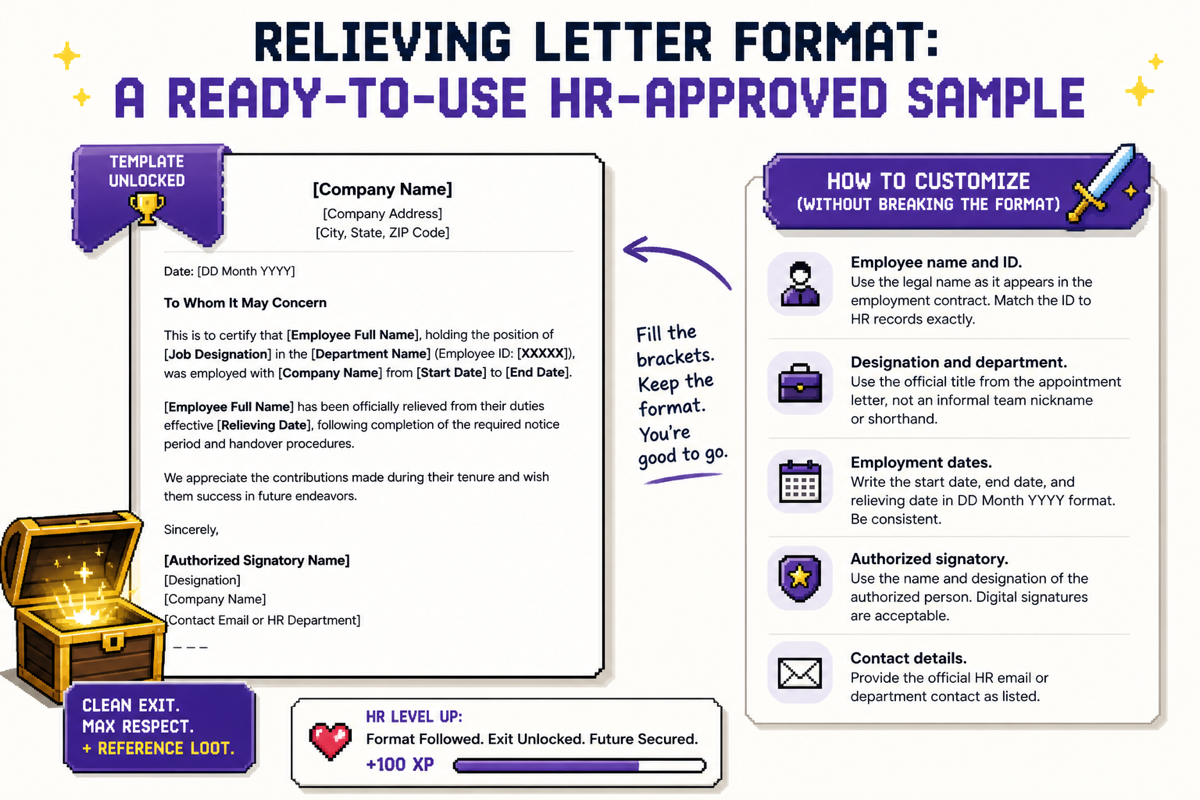
Relieving Letter Format: A Ready-to-Use HR-Approved Sample
The fastest way to get a clean letter issued or written is to show exactly what the finished document looks like. Use the sample below as a direct template. Every field maps to one of the five required elements covered above.
Sample Relieving Letter (Standard Employment Exit)
[Company Name]
[Company Address]
[City, State, ZIP Code]
Date: [DD Month YYYY]
To Whom It May Concern
This is to certify that [Employee Full Name], holding the position of [Job Designation] in the [Department Name] (Employee ID: [XXXXX]), was employed with [Company Name] from [Start Date] to [End Date].
[Employee Full Name] has been officially relieved from their duties effective [Relieving Date], following completion of the required notice period and handover procedures.
We appreciate the contributions made during their tenure and wish them success in future endeavors.
Sincerely,
[Authorized Signatory Name]
[Designation]
[Company Name]
[Contact Email or HR Department]
How to Customize Each Field Without Breaking the Format
Use this checklist when adapting the sample. Change only what is listed. Keep everything else verbatim.
- Employee name and ID. Use the legal name as it appears in the employment contract. Match the ID to HR records exactly.
- Designation and department. Use the official title from the appointment letter, not an informal team nickname or shorthand.
- Employment dates. Write the full date format: DD Month YYYY. Do not abbreviate months or use numeric-only formats.
- Relieving date. This must match the last working day confirmed in the resignation acceptance letter. Mismatches cause background check failures.
- Authorization block. The signatory must have the authority to issue exit documents. A peer's signature does not count. HR manager or above only.
Keep the letter under 200 words. The shorter it is, the less room there is for language that could be misread or disputed later.
Standard vs. Immediate Resignation: Which Relieving Letter Format Applies
The five required elements never change. What changes between a standard exit and an immediate resignation is the tone, the relieving statement language, and in some cases, the authorization chain.
Standard Notice Period Exit — Format Stays the Same
When a full notice period is served, the relieving letter format follows the sample above without modification. The only variables are dates. The tone remains neutral and professional. There is no need to add explanatory language about why the employee is leaving.
- Notice period · Standard Exit: Fully served · Immediate Resignation: Waived or partially served
- Tone · Standard Exit: Neutral, professional · Immediate Resignation: Neutral, brief, factual
- Relieving statement · Standard Exit: "Relieved after completing notice period" · Immediate Resignation: "Relieved effective [date] upon mutual agreement"
- Authorization required · Standard Exit: HR manager · Immediate Resignation: HR manager plus senior management sign-off
Immediate Resignation or Short Tenure — What Changes in the Letter
With immediate resignation, the relieving statement must reflect that the exit was by mutual agreement or that the notice period was waived. Do not use language that implies the employee abandoned their role. That phrasing can surface during reference checks and create problems. Keep it factual: the effective relieving date, the mutual agreement, and nothing else.
Short tenure exits, under three months, follow the same format. Do not omit the start date because the duration looks brief. Background agencies verify exact dates regardless of tenure length.
Speaking of compressed timelines — finding a new role fast enough to make an immediate resignation worth the risk is its own boss fight. Elip's AI job agent runs 24/7 inside your messaging app, filtering junk listings and locking in first-applicant status while you are busy wrapping up handovers. No cost, no tab-switching, just relevant job matches delivered before the queue fills up.
Remote and Hybrid Exits — Email Relieving Letter Etiquette in 2026
For fully remote employees, a PDF on official letterhead sent via the company's HR email address carries the same weight as a physical letter. The format does not change. A scenario that comes up often is an employee who submits a leave application for office for personal reasons, extends that leave, and then formally exits. In that case, the relieving letter format applies in full regardless of whether the employee ever returned to the office. The exit is still official and requires all five elements.
5 Relieving Letter Format Mistakes That Get HR to Push Back
These are the five traps that send your relieving letter back to spawn.
- Missing the Explicit Relieving Date. If the letter confirms employment history but does not state the official relieving date, background check agencies flag it as incomplete. Fix: add one sentence stating "relieved effective [date]" before the closing paragraph. This is the single most common rejection trigger.
- Vague Employment Duration — Month Only vs. Full Date. Writing "January 2022 to March 2024" instead of "12 January 2022 to 15 March 2024" creates a discrepancy when an agency cross-references exact dates on a resume. Fix: always use the full DD Month YYYY format for both the joining date and the last working day.
- Unsigned or Unauthorized Letters That Fail Background Checks. A relieving letter without a physical or digital signature from an authorized HR representative is not valid. Fix: confirm the signatory has HR issuance authority before submitting the letter for processing.
- Wrong Font, Informal Language, or Missing Letterhead. A relieving letter written in an informal font or on plain paper without letterhead reads as unofficial. Fix: use Arial, Calibri, or Times New Roman at 11 or 12 points, on official letterhead, with single spacing throughout.
- Delayed Issuance. Holding a relieving letter past the last working day is not a neutral act. It signals process failure to the outgoing employee's new employer and leaves the issuing company exposed to follow-up disputes. Once the exit process is complete, delaying the letter adds no value and increases both follow-ups and dissatisfaction. Fix: issue the letter on or before the last working day. Timeliness is a signal of process maturity.
FAQ
What is the difference between a relieving letter and an experience letter?
A relieving letter confirms that an employee has been officially released from their duties as of a specific date. An experience letter confirms the role held and duration of employment, often with a note on performance. Both are separate documents. Some companies issue them together, but HR and background agencies treat them as distinct records.
Can a company legally withhold a relieving letter after full notice is served?
Once a full notice period is served and exit formalities are complete, withholding a relieving letter creates legal exposure for the employer. The employee has fulfilled their contractual obligations. Most employment agreements and local labor regulations treat the issuance of exit documents as a standard post-notice requirement.
How long does HR typically take to issue a relieving letter?
Most organized HR teams issue the relieving letter on or before the last working day. Delays beyond one to two weeks after the last day are a process failure, not standard practice. If the letter has not arrived within five working days of your last day, send a formal written request to HR and document the communication.
Is a relieving letter required even when submitting a leave application for office for personal reason before exiting?
Yes. Whether an employee takes personal leave before their final exit date or reports to work every day through their last day, the relieving letter format and issuance requirement remains the same. The leave does not replace or waive the need for an official relieving document. The exit is still formal and requires all five standard elements.
What should I do if my new employer needs the relieving letter before HR issues it?
Notify your new employer immediately and provide the resignation acceptance letter as an interim document. Most onboarding teams accept this as proof of exit initiation while the final letter is processed. Follow up with HR in writing, specify the deadline your new employer has given you, and escalate to senior HR or a manager if the letter is not issued within five working days.
Conclusion
You now have the format, the sample, the comparison table, and the mistake list. The only variable left is how fast you move on it. A clean relieving letter is the final checkpoint before the next level loads. Clear it, and your new employer's onboarding process can start without a single hold.
But a clean exit only matters if the next opportunity is already in motion. A spotless relieving letter means nothing if you are still manually refreshing job boards six weeks after your last day.
If your next role is not already in the pipeline, that is where Elip comes in. Drop a message to Elip's AI job agent. It runs 24/7 in your chat app, screens out ghost listings, and makes sure you are first in the queue before 50 other applicants have even refreshed the page. Free to use. No spreadsheets. Just matches.