

You've done the work. You've delivered the results. Now you're staring at a blank email draft wondering why the hardest part of getting a raise is actually asking for one. Most employees grind the XP, then blow the final boss fight with a vague, apologetic email that gets filed under "deal with later" and forgotten.
Here's the reality check: salary budgets at U.S. companies are holding flat, with average increases expected to stay around 3.5% heading into 2026. That pool is not growing. The employees who get a meaningful slice are the ones who make a documented, well-timed, impossible-to-ignore case. Everyone else waits.
A strong application for increment in salary is not a favor request. It is a business case. Get the format right and you stop feeling like you're begging and start feeling like you're negotiating.
This article gives you a subject line formula, a five-part format, and three copy-paste samples you can adapt today.
What Is an Application for Increment in Salary (and When Should You Send One)?
A salary increment application is a formal written request asking your employer to increase your base pay. It documents your justification, whether that is performance, expanded responsibilities, or market rate gaps, and gives your manager something concrete to bring into budget conversations.
Knowing what to write matters. Knowing when to send it matters more.
Formal Letter vs. Email: Which Format Wins in 2026?
Email wins in almost every modern workplace. It creates a written record, reaches your manager directly, and allows them to forward it to HR or leadership without losing context. A printed letter still works in traditional industries or when your company culture expects formality.
When in doubt, match the format to how your company handles other formal requests. If your team sends leave applications for office for personal reason via email, your salary request belongs there too.
The Timing Sweet Spot: Budget Cycles, Review Windows, and Red Flags to Avoid
Timing your request well is half the battle. The strongest window is two to three months before your company's fiscal year-end. That is when managers are building budgets for the next cycle and a raise request can be factored in before the numbers are locked.
If you are a newer employee, wait at least six months before asking. You need a track record on the table, not just a promise of future performance.
Never send this letter right after layoffs, a project failure, or a major org change.
Those moments kill leverage. A manager under pressure will default to no, and now you are associated with bad timing. Wait for a win, wait for a calm quarter, and then make your move.
How to Write an Application for Increment in Salary: Subject Line and Format
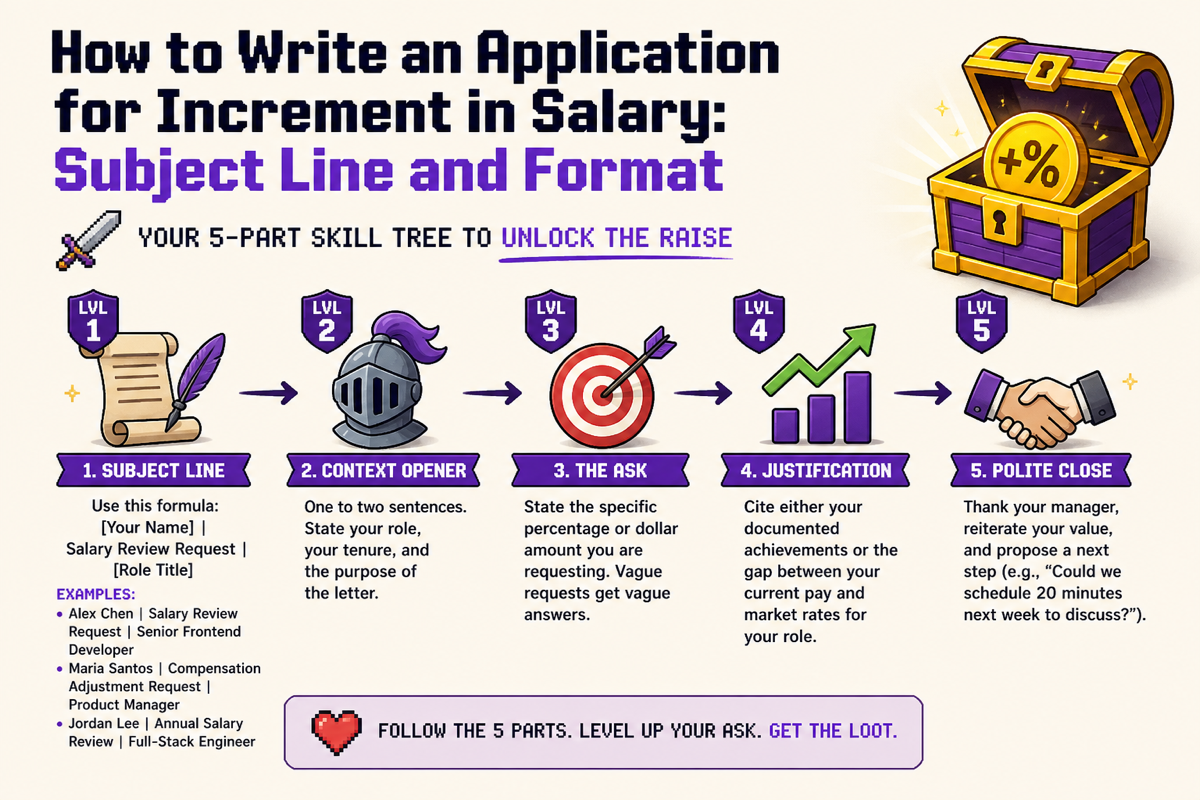
An application for increment in salary should include: (1) a clear, specific subject line, (2) your current role and tenure, (3) a specific raise amount backed by market or performance data, (4) a bullet list of your key achievements, and (5) a polite closing with a proposed next step. That five-part structure is your skill tree for this conversation. Build it in order and nothing gets missed.
Subject Line Formula That Gets Opened
Your subject line is the first impression and most people waste it. "Request" or "Quick question" tells your manager nothing and competes with thirty other emails.
Use this formula: [Your Name] | Salary Review Request | [Role Title]
Three copy-paste examples:
- "Alex Chen | Salary Review Request | Senior Frontend Developer"
- "Maria Santos | Compensation Adjustment Request | Product Manager"
- "Jordan Lee | Annual Salary Review | Full-Stack Engineer"
Specific, professional, and impossible to archive without reading.
The 5-Part Body Structure
Part 1: Context opener. One to two sentences. State your role, your tenure, and the purpose of the letter. No fluff.
Part 2: The ask. State the specific percentage or dollar amount you are requesting. Vague requests get vague answers. Anchoring with a number keeps the conversation concrete.
Part 3: Market or performance justification. This is your evidence round. Cite either your documented achievements or the gap between your current pay and market rates for your role. One paragraph, tight.
Part 4: Achievement bullets. Three to five bullets. Specific, quantified where possible. This is not a resume dump, it is a highlight reel.
Part 5: Closing with a next step. Thank them for their time and propose a specific follow-up. "I would welcome a 20-minute conversation this week" works better than "Let me know what you think."
Tone and Language: Professional Without Being a Pushover
Two mistakes cancel out good letters before the manager finishes reading.
The first is being too apologetic. Phrases like "I hope this isn't too much to ask" or "I completely understand if this isn't possible" signal that you don't believe your own case. If you don't believe it, they won't either.
The second is being too aggressive. Ultimatums and comparisons to what colleagues earn create defensiveness, not generosity. You are presenting a business case, not issuing a demand.
Confident and collaborative is the tone. You are telling them: here is what I bring, here is what the market says, here is what I am asking for. That is a conversation they can work with.
Sample Application for Increment in Salary (3 Scenarios)
Sample 1: Performance-Based Raise Request
Subject: Jordan Lee | Salary Review Request | Backend Developer
Dear [Manager Name],
I have been with [Company] for two years as a Backend Developer and I would like to formally request a salary increase of 12% to [target amount].
Over the past year I shipped three major features ahead of schedule, reduced API response time by 30%, and mentored two junior developers through onboarding. My contributions have grown consistently since my last review.
I would appreciate the opportunity to discuss this further at your earliest convenience.
Best regards,
Jordan Lee
When to use this: You have concrete results from the past 6 to 12 months and a clean performance record.
Sample 2: Market Adjustment Request
Subject: Priya Nair | Compensation Review Request | Frontend Developer
Dear [Manager Name],
I am writing to request a compensation review for my role as Frontend Developer. Based on current market data for my experience level and tech stack, my salary sits roughly 15% below the market median in this region.
With salary budgets holding flat industry-wide, I recognize the timing requires a strong case. My output, tenure of three years, and consistent positive reviews reflect a level of contribution that aligns with the higher end of that range.
I welcome a conversation to find a solution that reflects both market realities and my value to the team.
Best regards,
Priya Nair
When to use this: Your pay has not kept pace with market rates and you have data to support that gap.
Sample 3: Expanded Responsibilities Request
Subject: Marcus Webb | Salary Adjustment Request | Engineering Lead
Dear [Manager Name],
Since my last salary review, my role has expanded significantly. I now lead a team of five engineers, manage client-facing sprint reviews, and own the deployment pipeline for our primary product, responsibilities that were not part of my original scope.
I am requesting a salary adjustment of 18% to reflect this expanded remit. The additional accountabilities are documented in my recent performance review, and I am happy to walk through them in detail.
I appreciate your time and look forward to your thoughts.
Best regards,
Marcus Webb
When to use this: Your role has grown materially beyond your original job description and the scope increase is documented.
Expanded responsibility is the strongest argument when it is written down. Verbal acknowledgments fade. A letter creates a record that HR and leadership can reference.
You nailed the letter. But what if the answer takes weeks, or stalls entirely? While your increment request sits in review, Elip's AI job agent is already scanning the market 24/7 inside your messaging app, so you never have to manually refresh job boards or compete as applicant number 51. It filters junk, guarantees you first-applicant status, and costs nothing. Your career should not wait on one email.
What to Do After Sending Your Application for Increment in Salary
Sending the letter is not the finish line. Most professionals write a strong request, hit send, and then go passive. That silence is the hidden mistake. A raise request with no follow-up plan is like a great resume that never gets a callback because nobody chased it.
The Follow-Up Timeline: When to Nudge, When to Wait
Wait five to seven business days after sending before following up. A short, professional nudge is appropriate: "I wanted to check in on my salary review request from last week and see if you had time to review it."
If your company has a scheduled performance review cycle, ask your manager before the cycle starts so they can factor your request into the budget discussion as it opens. Requesting mid-cycle, after numbers are locked, puts them in a harder position to say yes.
One follow-up is professional. Two in the same week is pressure. Respect the pace of internal decision-making while staying visible.
If the Answer Is No: Your Next Move
A no is not a dead end. It is a cheat code request. Ask directly: "What specific targets or milestones would support a salary review in the next 90 days?" Get the answer in writing if you can.
Then set a specific check-in date. "Can we revisit this in 90 days?" gives both sides accountability and gives you a documented path forward.
Use this moment to understand what the actual performance bar looks like from your manager's perspective. That gap is your next quest objective.
If you are navigating multiple formal workplace requests at once, a relieving letter format or a branch transfer request letter format can serve as useful reference points for how your company structures official documentation. Keeping all your professional correspondence at the same level signals that you take the formal process seriously.
Frequently Asked Questions
What is the best subject line for a salary increment request?
The best subject line includes your name, the phrase "Salary Review Request," and your job title. For example: "Alex Chen | Salary Review Request | Senior Developer." This format is specific enough to stand out in an inbox and professional enough to be forwarded to HR without edits.
How much of a salary increase should I ask for?
Root your request in market research for your role, experience level, and region rather than a round number. A 10 to 20% range is common for employees who have taken on more scope or whose pay has fallen behind market rates. If your goal is a standard merit increase, align your ask with what is realistic given your company's review cycle.
How do I write a short application for increment in salary?
State your role and tenure in one sentence, name the raise amount you are requesting, list three to five specific achievements as bullet points, and close with a proposed next step. Keep the whole letter under 200 words. Brevity signals confidence, not lack of effort.
When is the worst time to send a salary increment application?
Avoid sending a salary increment request immediately after layoffs, a failed project, or a major leadership change. These moments put managers in a reactive position and a no becomes the default. Also avoid sending during the final weeks of a budget cycle when numbers are already locked.
Can I request a salary increment via email or does it need to be a formal letter?
Email is appropriate for most modern workplaces and creates a useful written record. A printed formal letter is better suited to traditional industries or companies with highly structured HR processes. Match the format to how your company handles other formal requests like performance reviews or HR correspondence.
You Have the Map. Now Send the Letter.
You have the format, the samples, and the timing strategy. The only variable left is whether you send it. A well-written salary increment application is not just a request. It is a documented case for your professional value, something your manager can bring into a budget conversation with confidence.
If the raise lands, great. If it stalls or falls short, you already know your next move. The next level is finding an employer who values what you bring before you have to build the case from scratch.
Ready to level up regardless of how the raise goes? Elip's AI job agent runs 24/7 in your chat, finding, filtering, and delivering the right opportunities so you are always first in line. Zero cost. Zero job board scrolling. Just results.