

The average job post collects 50+ applications within the first hour. Recruiters spend under 7 seconds scanning each one. Your joining application for a job is not a formality. It is the character creation screen in a video game. Build it wrong and you never reach Level 1. Build it right and you skip the queue entirely.
A single missing field or incorrectly formatted document can stop your submission cold before a human ever reads your name. Most applicants treat this document like a text message. The ones who get callbacks treat it like a loaded weapon. This guide gives you the format, five ready-to-use samples, and the exact mistakes to avoid so your application lands in the yes pile, not the trash folder.
What Is a Joining Application for a Job (and Why Most People Write It Wrong)
Most people confuse a joining application with a cover letter. That confusion gets applications rejected before they are even read.
Definition: A joining application for a job is a formal written request submitted by a candidate to confirm their intent to join an organization after receiving a job offer or before a formal interview, including personal details, the role applied for, and a brief statement of intent.
It is not a personal essay. It is not a resume narrative. It is a structured, formal document with a specific job in your sights.
Joining application vs. cover letter: the key difference
A cover letter sells your personality and past. A joining application states your intent and confirms your fit for a specific role. Cover letters are exploratory. Joining applications are declarative.
Think of the cover letter as your character backstory. The joining application is you clicking "Accept Quest." One is optional flavor text. The other is a binding move in the game.
For job seekers targeting job search titles like "dispatch executive," "campus recruitment," or roles found through a job title search on niche portals, employers expect this document to be formal, brief, and structured. Not conversational.
When employers actually ask for a joining application
Employers ask for joining applications in three situations: before a formal interview to screen intent, after a verbal offer to confirm acceptance, and when applying through placement agencies or job portals where a standardized document speeds up processing.
If you are applying for what relevant experience you have to a structured organization like a government body, large FMCG brand, or airline, expect this format to be mandatory. For smaller private roles found through for job seeker portals, it still signals professionalism when others are sending informal emails.
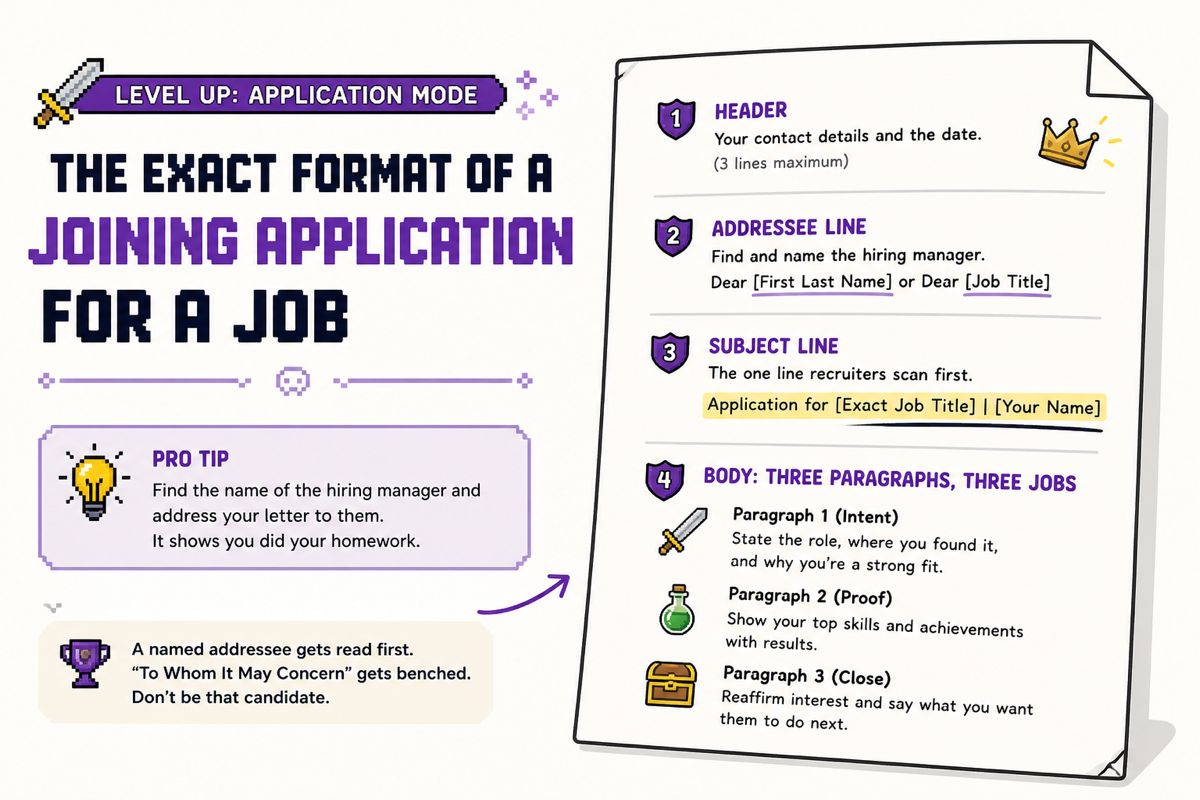
The Exact Format of a Joining Application for a Job
A badly structured joining application tanks your ATS score before a recruiter ever opens it. Here is every field, in order, with no guesswork.
Header: your contact details and the date
Place your full name, phone number, email address, and city at the top left. Add the date below. This block takes three lines maximum.
If you are submitting inside an online application form, skip the header block entirely. The form already captures your details. Duplicating it wastes space and looks like you copied a template without reading the instructions.
Addressee line: how to find and name the hiring manager
Pro Tip: Try to find the name of the person reviewing applications. Address your letter to this person with a greeting like "Dear [First Last Name]" or "Dear [Job Title]" rather than "To Whom It May Concern." Check LinkedIn, the company website, or the job listing itself for a name.
A named addressee signals research. "To Whom It May Concern" signals laziness. One of these gets read first.
Subject line: the one line recruiters scan first
Format it as: Application for [Exact Job Title] | [Your Name]
Mirror the job title exactly as it appears in the advertisement for recruitment. If the listing says "Ground Staff Associate," do not write "Airline Worker." Exact match language helps with ATS parsing and shows you read the post.
Body: three paragraphs that do three different jobs
Paragraph 1 (Intent): State the role you are applying for, where you found it, and one sentence confirming you meet the core requirement. Keep it to three sentences.
Paragraph 2 (Relevance): Name one or two specific skills or experiences that match the job description. Use numbers where you have them. "Managed a 12-person team" beats "experienced in leadership."
Paragraph 3 (Close): Confirm your availability, request next steps, and thank the reader. One sentence each. No fluff.
Sign-off and attachments checklist
Close with "Yours sincerely" or "Respectfully yours" followed by your full name. Below your name, list attachments: Resume, Certificates, ID Proof. Do not leave this blank. Forgetting attachments is one of the top reasons applications stall.
On ATS score meaning: A well-structured joining application that mirrors the job description's exact language scores higher with applicant tracking systems. A good ATS score sits at 70 percent or above. Use the job posting as your word bank.
Joining Application Samples for 5 Common Job Scenarios
Blank-page paralysis costs you time. Time costs you the application. Pick the sample closest to your situation, edit the bold fields, and send.
Sample 1: Fresh graduate applying to a private company
Dear Hiring Manager,
I am writing to apply for the position of [Job Title] at [Company Name], as advertised on [Portal/Source]. I recently completed my [Degree] from [University] and am eager to begin my career in a results-driven environment. My coursework in [Relevant Subject] and internship at [Organization] have prepared me for this role. I am available to join immediately and would welcome the opportunity to discuss my application. Please find my resume and certificates attached.
Respectfully yours,
[Your Name]
Why this works: It leads with the role, not the candidate's life story. It names a specific qualification and signals immediate availability. Both details matter for latest jobs private company listings where speed is everything.
Sample 2: Experienced candidate applying to a tech or software role
Dear [Hiring Manager Name],
I am applying for the [Software/Tech Role] position at [Company Name]. With [X] years of experience in [Specific Stack or Function], I have delivered [one measurable outcome] in my current role at [Employer]. I am confident my background aligns with your requirements for this position. I would appreciate the opportunity to discuss how I can contribute. Resume and portfolio are attached.
Sincerely,
[Your Name]
Why this works: It opens with a measurable outcome, not a vague claim. For from software jobs and campus recruitment roles at tech firms, specificity is the difference between a callback and silence.
Finding the right opening before 50 other developers do is where most people lose. Elip's AI job agent runs 24/7 inside your messaging app, hunting live postings across platforms, filtering ghost listings, and alerting you the moment a real match appears. You apply first instead of arriving late to a closed race. No dashboard, no subscription.
Sample 3: Applying for airport or airline ground staff jobs
Dear [HR Manager / Recruitment Team],
I am writing to express my intent to join [Airline Name] as [Ground Staff Role], as listed on [Source]. I hold a [relevant certificate or qualification] and have prior experience in [customer handling / baggage operations / check-in]. I am physically fit, available for rotational shifts, and committed to service standards. I would welcome a formal interview at your convenience. Documents are attached.
Respectfully,
[Your Name]
Why this works: For indigo airline ground staff jobs, indigo ground staff jobs, or any recruitment airport job, the hiring team screens for shift readiness and physical fitness. Naming both upfront removes doubt and speeds up the shortlisting process.
Sample 4: Applying through a placement agency or job portal
Dear [Agency Coordinator Name],
I am registering my application for [Job Title] through your agency. I have [X] years of experience in [Field] and am currently seeking roles in [City/Region]. My resume details my qualifications and references. Please find all documents attached. I am available for a telephonic interview or in-person meeting at short notice.
Sincerely,
[Your Name]
Why this works: Placement agencies in Delhi and job placement agencies in Amritsar process dozens of profiles daily. A clean, complete document with attached references moves faster through their pipeline than a casual email.
Sample 5: Applying for a coaching institute or education sector role
Dear [Principal / HR Manager],
I am applying for the position of [Subject Teacher / Academic Coordinator] at [Institute Name]. I hold a [Degree/Certification] in [Subject] with [X] years of teaching experience at [Previous Institute]. I am passionate about student outcomes and comfortable with both classroom and online delivery formats. I would be pleased to discuss this role further. Resume and copies of certificates are attached.
Yours sincerely,
[Your Name]
Why this works: For coaching institute jobs, coaching center jobs, and jobs in coaching institute, decision-makers want subject clarity and a signal of commitment fast. This format delivers both without padding.
7 Mistakes That Get Your Joining Application Rejected Before Anyone Reads It
A single missing field or incorrectly formatted document can stop your application from being submitted. Pre-screening questions filter candidates before anyone reaches your letter. Here are the errors that end applications before they start.
- Generic opener ("I am writing to apply for a position at your esteemed organization"). Fix: Name the exact job title in sentence one. Show you read the listing.
- Wrong or missing addressee. Fix: Spend two minutes finding the hiring manager's name. "Dear Rahul Sharma" beats "Dear Sir/Madam" every time.
- Vague experience claims. Fix: Replace "I have strong communication skills" with "I handled 40+ client calls daily at [Company]." Numbers survive scanning. Adjectives do not.
- Ignoring ATS formatting rules. Fix: Use standard fonts, no tables inside the letter, and mirror exact keywords from the job description. ATS score meaning in practice: your document is parsed before a human sees it. A score below 70 percent means you are invisible.
- Sending a .pages file or forgetting attachments. Fix: Export as PDF unless the job post specifies .docx. List every attachment at the bottom of your letter and double-check before sending.
- One application sent to every job. Fix: Change the job title, company name, and one relevant skill per application. Templated applications read like templated applications.
- Ignoring speed on Telegram job groups. For roles sourced from a telegram jobs group or job telegram group, employers post and fill in hours. An error-free application sent within 30 minutes of posting beats a polished one sent the next morning.
How to Find the Right Jobs to Send Your Joining Application To
A perfect application sent to a ghost listing is a wasted move. Match your channel to your role type before you write a single word.
Job boards vs. direct company portals: where applications actually land
Direct company portals at firms like Reckitt, Xpressbees, or Expedia route applications straight to internal HR. Job board aggregators collect listings but add a processing lag. For urgent job hiring situations, direct portals win on speed.
- Tech / Software · Best Channel: Direct portal, Glassdoor job search, LinkedIn · Joining Application Tip: Mirror job description keywords exactly for ATS
- Airline / Airport · Best Channel: Indigo careers portal, recruitment airport job boards · Joining Application Tip: State shift availability and fitness upfront
- FMCG (Reckitt, Eureka Forbes) · Best Channel: Company careers page, gems job portal · Joining Application Tip: Include territory or region preference in body
- Logistics (Xpressbees, dispatch executive) · Best Channel: Company portal, job board aggregator · Joining Application Tip: Note driving license or logistics certifications
- Travel / Events (Expedia, travel companies, event management) · Best Channel: Company site, niche travel job boards · Joining Application Tip: Highlight client-facing experience and languages
- Education / Coaching · Best Channel: Institute website, walk-in drives, local ads · Joining Application Tip: Lead with subject and board/curriculum experience
Using Telegram job groups and niche portals without wasting time
Telegram job groups surface real openings fast, especially for roles in searching for jobs in Hyderabad or tier-2 cities. The risk is ghost postings. Always verify a listing is live by checking the company website or calling the placement office before applying.
For eclerx walkin interview or telephonic interview jobs, the joining application doubles as an intro email. Keep it under 150 words, skip the full header, and lead with your most relevant credential.
How placement agencies and recruiters process joining applications
Placement agencies in Delhi and job recruiters in Pune typically forward your application as-is to the employer. A polished joining application makes that handoff cleaner. For international roles through a Germany job agency, job recruitment agencies in Saudi Arabia, or immigration consultants, expect additional document requirements. Include a covering note listing every document in the package.
Frequently Asked Questions
What is the difference between a joining application and a cover letter?
A joining application is a formal document confirming your intent to join a specific organization for a specific role, including personal details and a statement of intent. A cover letter is a persuasive narrative supporting your resume. The joining application is structural. The cover letter is editorial.
How long should a joining application for a job be?
One page maximum. Three body paragraphs, a clear subject line, and an attachments list. If your application runs longer than 300 words in the body, you are writing a cover letter, not a joining application.
Can I use the same joining application for multiple jobs?
No. Change the job title, company name, addressee, and one specific skill reference for every application. A generic joining application signals low effort and fails ATS keyword matching for each unique role.
What should I write in the subject line of a joining application?
Use this format: Application for [Exact Job Title] | [Your Full Name]. Mirror the job title as it appears in the listing. Exact match language helps applicant tracking systems and tells the recruiter at a glance what they are opening.
Does a joining application need to follow ATS formatting rules?
Yes, when submitted digitally. Use a standard font like Arial or Calibri at 11 or 12 points, avoid tables or text boxes inside the document, and repeat key phrases from the job description. A good ATS score is 70 percent or above. Submitting a clean, keyword-matched document is the minimum requirement for getting past automated screening.
Ready to Send? Here Is the Final Check
Before you hit submit, run this three-part test. Do you have the right format? Do you have a sample adapted to your specific role? Do you have a live, verified job opening to send it to?
If the first two are yes but the third is missing, that is the boss fight most job seekers lose. Not because of bad writing. Because they found the listing two days late and applied to a role already quietly filled. The application is the weapon. Knowing where and when to fire it is the actual game.
Try Elip free. It finds and filters live job matches in your chat app so your next joining application lands before the rush, not after it.
Related reading
- How to Write a Relieving Letter Format That HR Actually Accepts
- How to Write a Leave Application for Office for Personal Reason (With Templates That Get Approved)
- Application for Increment in Salary: Subject Line, Format, and Sample
- How to Write a Branch Transfer Request Letter That Gets Approved
- 7 Best Job Placement Agencies in Amritsar for Tech Roles (And One Cheat Code That Works 24/7)