
Every few weeks someone on r/developersIndia asks a version of the same question: can you get from a service company to a product company, and how long does it really take?
The answers are always anecdotes. One person did it in eighteen months. Another spent six years and gave up. Neither tells you what is typical.
So we went looking for the actual distribution. Our agents index public career histories at scale, and we pulled every profile we could find of someone who currently works at Google and has TCS somewhere in their past. That came to 1,512 people.
Here is what their careers actually look like.
Almost nobody goes straight from TCS to Google
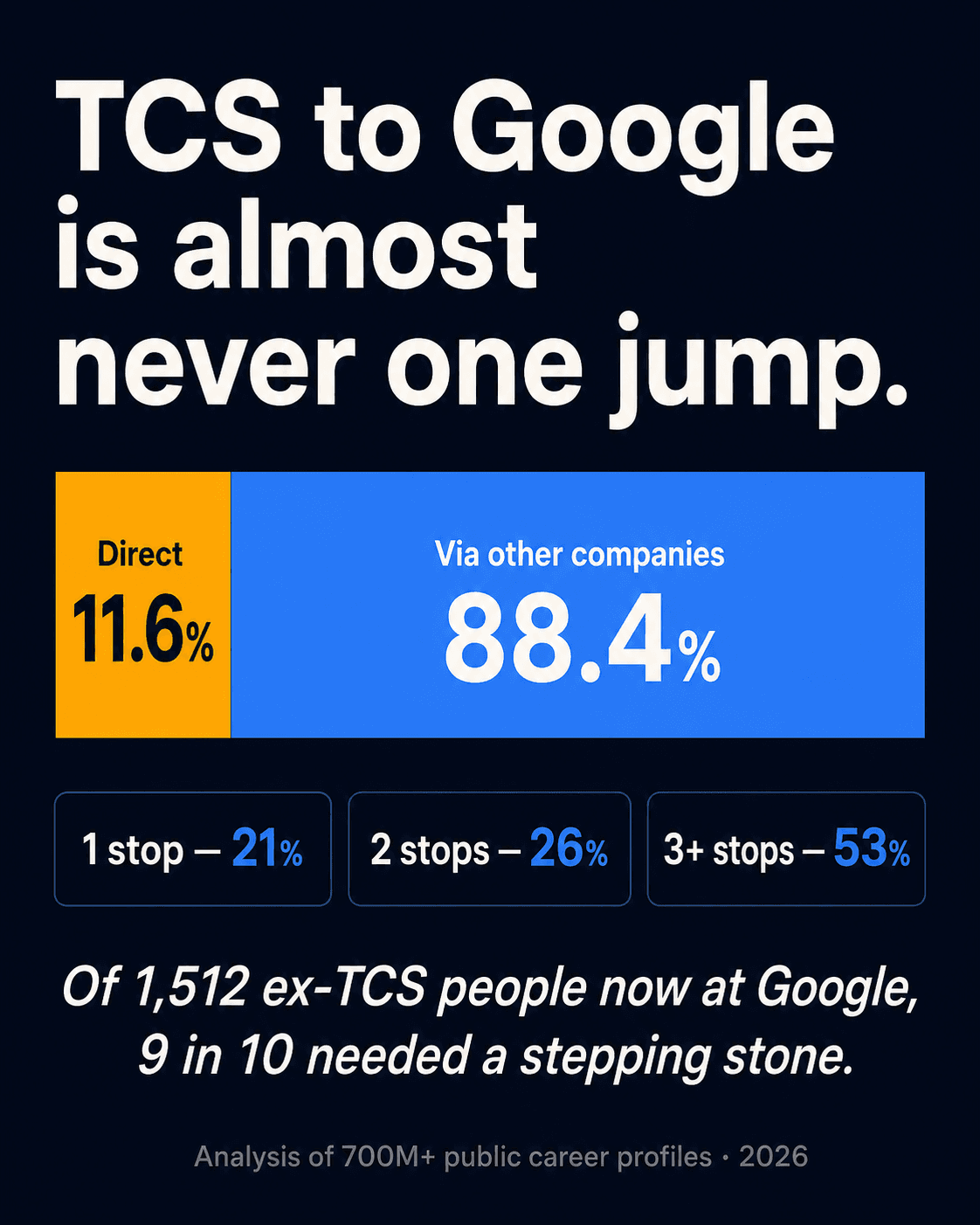
Of the 1,512, exactly 176 went directly — TCS was the job immediately before Google. That is 11.6%.

The other 88.4% took at least one company in between. Breaking that group down:
- 21% had exactly one company between TCS and Google
- 26.1% had exactly two
- 52.9% had three or more
More than half needed three or more moves. The single-leap story that dominates LinkedIn is the rarest outcome in the data.
And 11.6% is generous. Roughly 12% of those 176 "direct" profiles show a one-to-two year gap between leaving TCS and starting at Google — almost certainly a masters degree that was never added to the profile. Strip those out and the true direct rate is closer to 10%.
The stepping stone is almost always Amazon
If the path runs through other companies, which ones? We looked at the last employer before Google for the 1,336 people who did not come directly.

The full top ten, by number of people:
- Amazon (incl. AWS) — 133
- Microsoft — 58
- Oracle — 38
- VMware — 20
- Cisco — 19
- SAP — 17
- Qualcomm — 17
- Accenture — 16
- Intel — 14
- Deloitte — 14
Amazon appears more often than the next three combined. The top five are all product companies — the only services firms anywhere in the top ten are Accenture at #8 and Deloitte at #10, and together they account for 30 of 1,336 paths.
The practical reading: the job that gets you into Google is usually not the one you take straight out of TCS. It is the one after that. Your first move out of a service company matters mostly because of where it lets you go next.
One more thing worth flagging. Amazon accounted for roughly 3% of these paths before 2018. From 2019 onward it sits at 11–13%. Amazon's India engineering expansion did not just hire people — it became the main corridor into the rest of the industry.
They left at year two
Median tenure at TCS for people who eventually reached Google: 2.2 years.

The distribution is front-loaded. 19% left inside a year, 23% between one and two years, another 23% between two and three. By the three-year mark, 65% were already gone.
For context, that is about 10 months earlier than the average TCS leaver. The people who got to Google were not the ones who waited to be promoted.
But leaving earlier has not made the trip faster
This is the finding we did not expect, and it complicates the obvious advice.

Split by the year someone left TCS:
- Pre-2016: 2.8 years at TCS, then 4.5 years to Google
- 2019–22: 2.4 years at TCS, then 6.5 years
- 2024–25: 1.9 years at TCS, then 5.5 years
People are leaving a full year earlier than they did a decade ago, and the total road to Google has still got longer — from 4.5 years to somewhere between 5.5 and 6.5.
Quitting sooner is not the lever. The number of hops in between is doing the work, and each hop takes time regardless of how early you start.
One caveat on that last data point: the 2024–25 figure can only count people who have already arrived at Google. Anyone still two hops away is invisible to it. That number will likely move as those careers finish playing out.
What we cannot see
This is survivor data, and the limitation is not a footnote — it changes what you are allowed to conclude from it.
We can only observe people who made it to Google. We cannot see the person who left TCS for Amazon, stalled, and is still at Amazon eight years later. We cannot see the person who left for a startup that folded. For every path in this dataset there is an unknown number of people who took the same first step and never arrived.
So the honest version of the Amazon finding is not "go to Amazon and you will get to Google." It is "of the people who reached Google, most came via Amazon." Those are different claims. The first is a strategy. The second is a description. Only the second is supported here.
Two smaller limits: everything comes from self-reported public profiles, so short stints and unlisted degrees are systematically undercounted. And smaller employers are underrepresented relative to the ones people bother to keep updated.
It is not just TCS
We ran the same analysis across all five major Indian IT services firms — 5,129 people now at Google with one of them in their history.
- TCS — 1,512
- Infosys — 1,374
- Cognizant — 1,028
- Wipro — 1,026
- HCL — 614
The shape is the same across all five: a direct rate near one in ten, a median of two-ish years before leaving, and Amazon as the dominant intermediate stop. Different sizes, same structure. This is not a TCS story — it is a services-to-product story, and TCS is simply the largest sample of it.
What this actually means if you are in one right now
Four things the data supports, stated no more strongly than it allows:
- Stop optimising for the one-jump story. It is roughly a one-in-ten outcome, and part of that ten percent quietly went through a masters programme. Planning around it is planning around the exception.
- Judge your next move by what it opens, not what it pays. Over half the people here made three or more moves. The realistic question about any offer is which companies it makes reachable in two years.
- The two-year mark is a real signal, not a rule. People who reached Google left early — but leaving early did not shorten the total journey. Early exit correlates with the outcome; it does not cause it.
- Expect five to six years, not eighteen months. That is the median for people who succeeded. Anyone promising faster is selling something.
None of this says the path is closed. Five thousand people walked it. It says the path is longer and has more stops than the version that circulates on LinkedIn — and knowing the real shape of it is more useful than knowing the exceptional one.
This analysis comes from Elip's index of public career histories. If you want your own next move mapped against where people in your role actually go, that is what our agents do. Related: the software skills that actually show up on shortlisted resumes.