

A developer sends 80 applications. Three responses come back. The instinct is to blame the market, the economy, or bad luck. The real answer is sitting in the skills section of their resume, quietly killing every submission before a human ever reads it.
Vague entries like "experience with cloud tools" or "familiar with version control" are not skills. They are placeholders. In 2026, ATS bots and AI screeners run the first filter, and they match exact tool names against job descriptions. A resume full of resume software skills listed by category instead of name gets rejected at the gate.
This guide breaks down 15 specific software skills to list, how to format them so parsers can actually read them, and how to tailor the list to your target role. Think of it as upgrading your loadout before the boss fight starts.
Why Software Skills on a Resume Make or Break Your 2026 Job Hunt
ATS and AI Screeners Filter by Exact Tool Names, Not Categories
Employers are increasingly prioritizing AI and digital skills in 2026, and their screening software reflects that. ATS systems parse resumes by matching keywords in job descriptions to keywords in your resume. If a job post says "Terraform" and your resume says "infrastructure tools," the parser scores you a miss.
Software skills on a resume need to be precise. Write "PostgreSQL" not "database management." Write "GitHub Actions" not "CI/CD tools." The difference between getting parsed as a match and landing in the rejection pile is often a single word.
Hiring Managers Expect Evidence, Not Assertions
Getting past ATS is level one. The next fight is a hiring manager who has seen 40 resumes that all claim "strong technical skills." If an employer needs a developer with Docker experience, claiming "familiarity with containerization" does not close the deal. Naming the tool, pairing it with a project outcome, and listing any certification turns a generic claim into actual evidence. Software skills in resume entries that include context beat those that do not, every time.
How to Format Software Skills on Your Resume So ATS Actually Reads Them
Dedicated Skills Section vs. Inline in Work Experience
Use both. A dedicated skills section near the top gives ATS a clean block to parse. Repeating those skills inline in your work experience bullets gives hiring managers the context they need to believe you. One without the other leaves something on the table.
Proficiency Levels: Show Them or Skip Them?
Include proficiency levels only when they add information. "Python (Advanced)" is useful. "Slack (Intermediate)" is noise. If listing a level, keep the format consistent across all entries. Inconsistency reads as disorganization in resume presentation.
Professional Resume Font and Layout Choices That Won't Confuse Parsers
ATS software fails to read columns, tables, and unusual formatting correctly. A resume that looks polished in a two-column template gets scrambled into nonsense when a parser processes it. Use a single-column layout. Stick to a professional resume font like Calibri, Arial, or Georgia at 10 to 12 points. These are the best fonts for a CV when ATS compatibility matters. Submit as PDF unless the job post specifies Word. Skip headers, footers, and graphics entirely. The resume font style you choose should be boring by design. Boring parses.
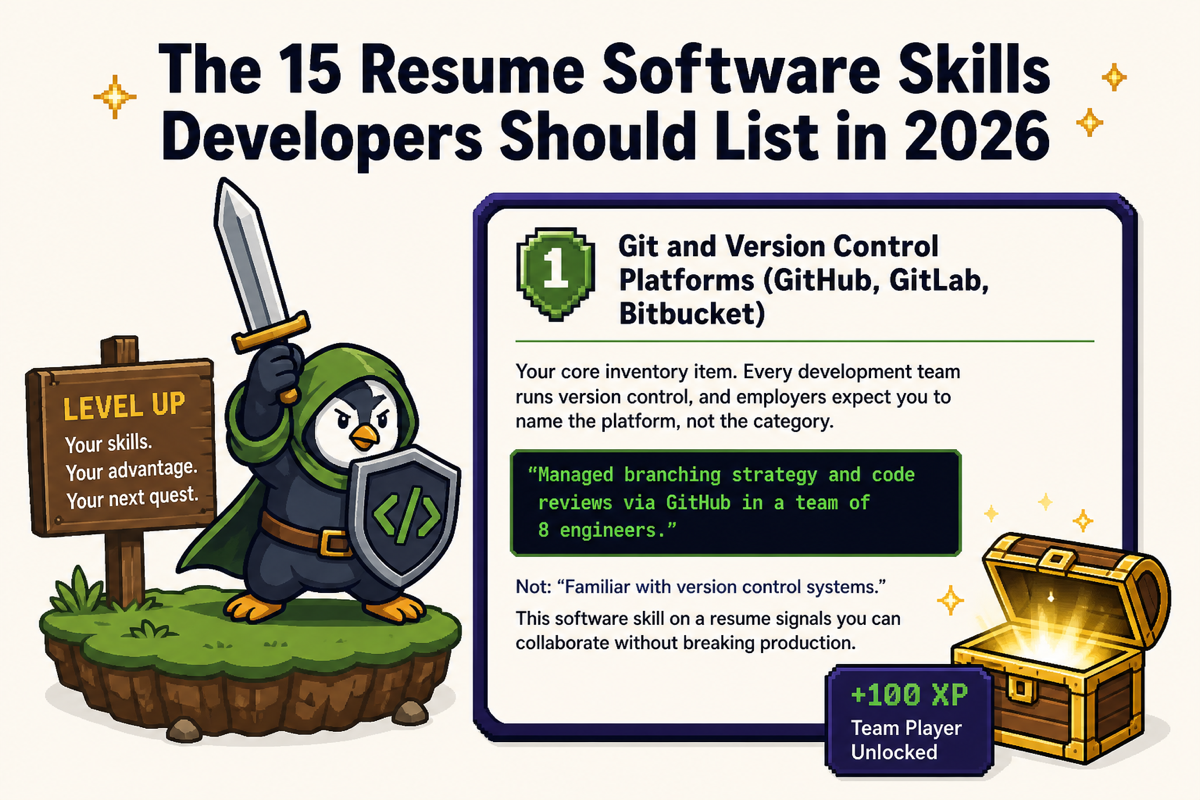
The 15 Resume Software Skills Developers Should List in 2026
1. Git and Version Control Platforms (GitHub, GitLab, Bitbucket)
Your core inventory item. Every development team runs version control, and employers expect you to name the platform, not the category. Write: "Managed branching strategy and code reviews via GitHub in a team of 8 engineers." Not: "Familiar with version control systems." This software skill on a resume signals you can collaborate without breaking production.
2. Cloud Platforms (AWS, Azure, Google Cloud)
Cloud fluency is non-negotiable in 2026. Name the specific services you have used, not just the platform. Write: "Deployed and scaled REST APIs on AWS using EC2, S3, and RDS." Employers scan for service names like Lambda, Azure Functions, or GCP Pub/Sub. "Experience with cloud tools" earns zero points with ATS.
3. Containerization and Orchestration (Docker, Kubernetes)
Containers are the standard unit of deployment. List both the tool and the context. Write: "Containerized microservices with Docker and orchestrated workloads using Kubernetes on AWS EKS." Kubernetes alone is a strong differentiator. If you have Certified Kubernetes Administrator credentials, list them next to the skill.
4. CI/CD Pipeline Tools (Jenkins, GitHub Actions, CircleCI)
Employers want developers who ship safely, not just developers who code. Write: "Built and maintained CI/CD pipelines using GitHub Actions to automate testing and deployment across staging and production environments." Name the pipeline tool exactly. Generic phrases like "automated deployment experience" disappear in ATS scoring.
5. AI and Machine Learning Frameworks (TensorFlow, PyTorch, Scikit-learn)
AI literacy is one of the top skill signals employers look for right now. Even if you are not an ML engineer, listing a framework you have used in a project shows genuine engagement. Write: "Built a text classification model using Scikit-learn with 91% accuracy on a validation set." Outcomes always outperform claims.
6. Agile and Project Management Software (Jira, Linear, Trello)
Resume project manager skills are not just for project managers. Developers who list Jira or Linear signal they can work in structured sprint cycles and communicate progress. Write: "Tracked sprint backlog and bug triage in Jira across two-week cycles with a team of six." This also functions as proof of communication on a resume without writing the words "good communicator."
7. IDEs and Code Editors (VS Code, IntelliJ, Vim)
This one is quick XP that most developers skip. Listing your primary IDE reassures employers you work in a professional setup and know your toolchain. Write: "Primary development environment: VS Code with ESLint, Prettier, and GitLens extensions." It signals detail orientation and stops a recruiter from wondering how you actually work.
8. API Development and Testing Tools (Postman, Swagger, REST)
API work sits at the center of almost every modern application. Write: "Designed and documented REST APIs using Swagger; tested endpoints with Postman before each release cycle." If you have GraphQL experience, list it here too. Specificity signals ownership, not just exposure.
Building this skills loadout is only half the battle. You still need to get it in front of the right roles before 50 other applicants do. Elip's AI job agent runs 24/7 in your messaging app, filters ghost listings automatically, and locks in your application first so your polished resume actually gets seen.
9. Database Management Systems (PostgreSQL, MongoDB, Redis)
List the database, the use case, and the scale if you have it. Write: "Designed schema and optimized queries in PostgreSQL for a platform serving 200K monthly active users." Mentioning both relational and NoSQL databases broadens your signal. Redis listed alongside a caching or session management use case reads especially well.
10. Monitoring and Observability Tools (Datadog, Grafana, Prometheus)
Developers who understand observability reduce incidents. Employers hiring for senior or mid-level roles increasingly look for this. Write: "Set up Grafana dashboards and Prometheus alerting rules to monitor API latency and error rates in production." This skill tells a hiring manager you own your code after it ships.
11. Security and DevSecOps Tools (Snyk, OWASP ZAP, SonarQube)
Security awareness in developers is a growing employer priority. You do not need a security title to list these. Write: "Integrated Snyk into CI pipeline to catch dependency vulnerabilities before merge." One sentence showing you baked security into your workflow beats a vague "security-conscious developer" claim every time.
12. Frontend Frameworks and Libraries (React, Vue, Next.js)
Frontend developers need to name their stack precisely. Write: "Built and maintained a React 18 component library with TypeScript, tested with Jest and React Testing Library." Framework versions matter. Listing "React 18" instead of just "React" signals you are current. Next.js listed alongside React signals you can handle server-side rendering and routing.
13. Infrastructure as Code (Terraform, Ansible, Pulumi)
This is a differentiating skill for developers moving toward DevOps or platform engineering. Write: "Provisioned multi-region AWS infrastructure using Terraform with state management in S3 and DynamoDB locking." Employers searching for infrastructure as code skills want exact tool names. Software resume skills at this level unlock senior-tier conversations.
14. Collaboration and Documentation Platforms (Confluence, Notion, Slack API)
These tools double as communication skills for a resume without using the phrase. Write: "Maintained technical runbooks and architecture decision records in Confluence for a team of 12 engineers." If you have built Slack integrations or bots via the Slack API, list it. It signals initiative beyond your core role.
15. Data and Analytics Tools (Tableau, Pandas, dbt)
Data analyst skills on a resume are increasingly relevant for full-stack and backend developers who touch reporting pipelines. Write: "Transformed and aggregated event data using Pandas and dbt, visualized in Tableau for weekly stakeholder reviews." Even one data tool on a developer resume broadens your match surface across more job postings.
How to Tailor These Software Skills to Specific Developer Roles
Frontend Developer Resume: Skills That Signal UI Ownership
Lead with React, Vue, or Next.js, then layer in testing tools and performance monitoring. Key accomplishments on a resume for frontend roles should tie to user-facing metrics: load time, Lighthouse scores, or conversion improvements. Two to three sentences of context per tool beats a list of ten names with no context.
Backend and Full-Stack: Depth Over Breadth
Pick a primary cloud platform and go deep. A backend resume that shows AWS Lambda plus PostgreSQL plus Docker plus monitoring is a coherent story. One that lists every cloud provider with no specifics reads as shallow. Depth signals ownership. Breadth without depth signals exposure.
Data and ML Engineers: Tools That Prove You Can Ship Models
Listing TensorFlow is not enough. Pair it with a deployment story: "Deployed a PyTorch inference endpoint on AWS SageMaker serving 500 predictions per minute." Data analyst skills on a resume gain weight when they connect to production, not just notebooks.
Entry-Level and Freshers: What to List When Experience Is Thin
Software development jobs for freshers require a different lens. Academic projects, open-source contributions, and course certifications all count as relevant experience when framed correctly. Write a beginner summary for your resume that leads with what you built, not what you studied. A GitHub link next to a project name tells a hiring manager more than a GPA.
Common Mistakes Developers Make When Listing Software Skills on a Resume
Listing Skills You Can't Back Up in an Interview
Trap: writing "Kubernetes" because it looked good, then freezing when asked to explain a deployment strategy. Fix: only list tools you can speak to for at least three minutes. Confidence in an interview is earned in the skills section of a resume.
Using Generic Category Names Instead of Tool Names
Trap: "experience with monitoring tools." Fix: "Datadog, Grafana, Prometheus." ATS matches on names. Categories are invisible to parsers and unimpressive to humans. This is the most common and most avoidable game-over in a job search.
Burying Skills in a Wall of Text Formatting That Breaks ATS
Trap: beautiful two-column resume with icons and shaded skill bars that a parser reads as garbled symbols. Fix: single column, standard font, no graphics. ATS systems fail to read creative layouts correctly, which means your resume disappears before a human sees it. Organization on a resume matters less than parsability.
Ignoring Soft Skills That Employers Actually Want Alongside Technical Ones
Trap: a resume that lists 15 technical tools with zero signal of collaboration. Fix: list tools that prove communication skills in a resume without using the phrase. Confluence shows documentation. Jira shows process. Slack API integrations show initiative. Leadership skills for a resume show up through context, not bullet points that say "strong leader."
Frequently Asked Questions
What software skills should a developer put on a resume in 2026?
Focus on tools that appear in your target job descriptions by exact name. Core picks include Git, a cloud platform (AWS, Azure, or GCP), Docker, a CI/CD tool, and at least one framework tied to your stack. Add AI or ML tools if you have used them in any capacity. Specificity beats volume every time.
How many software skills should you list on a resume?
Eight to fifteen skills is the practical range. Fewer than eight looks thin for a developer role. More than fifteen starts to read as a keyword dump, which damages credibility with hiring managers even if it passes ATS. Prioritize depth on five to eight core skills and support the rest with project context.
Should you list skill proficiency levels on a developer resume?
Yes, but selectively. Use proficiency levels for your most important tools where the distinction matters: "Python (Advanced)" or "AWS (Certified Solutions Architect)" adds real information. Skip levels for basic productivity tools or anything you list at beginner level. A beginner rating raises more questions than it answers.
What is relevant experience for a software developer with no job history?
Relevant experience includes academic projects, open-source contributions, freelance work, hackathon builds, and personal GitHub repositories with documented code. Frame each with a tool, an outcome, and a scale when possible. Certifications from AWS, Google, or Microsoft also function as proof of skill when job history is thin.
Can soft skills like communication actually help a developer's resume?
Yes, when they are demonstrated rather than stated. Listing Confluence, Jira, or Slack API usage signals collaboration and communication on a resume more effectively than a bullet point that reads "excellent communicator." Hiring managers connect dots when they see tools that require teamwork. They ignore assertions that claim teamwork without evidence.
What resume upload sites should developers use to find jobs?
The standard job resume upload sites include LinkedIn, Indeed, Dice, and Wellfound for startups. Stack Overflow Jobs has a developer-specific audience. GitHub profile pages function as a passive resume upload site when kept active. The real problem is not which site to use but how to stay ahead of applicants who apply within the first hour of a posting going live.
Your Skills Loadout Is Ready. Now Use It.
You have the skills list. You know how to format it, how to tailor it by role, and which mistakes quietly kill applications. The question now is not whether your resume is good enough. It is whether your resume is getting submitted first, or sitting in a pile of 80 other applications while recruiters close the funnel.
Applying more is not the answer. Applying smarter, to the right roles, before the rush hits, is the actual unlock. Ghost listings, scattered job boards, and roles that close before most candidates even see them are the real obstacles now.
Your resume is ready. Now make sure it gets there first. Elip's AI job agent runs in your chat app around the clock, finding real developer roles, cutting ghost listings, and submitting your application before the rush hits. Start your free session at tryelip.ai and let the agent do the grinding while you prep for the interview.
Related reading
- 10 Best Resume Communication Skills for Software Developers (With Real Examples)
- How to Download Your Resume from LinkedIn in 3 Steps
- Recruiter Jobs on Indeed: 7 Tips to Get More Callbacks
- 10 Best B.Com Job Vacancies for Fresh Graduates in 2026
- Job Vacancy Urgent Hiring: 7 Sites That Actually Get You Interviewed Fast